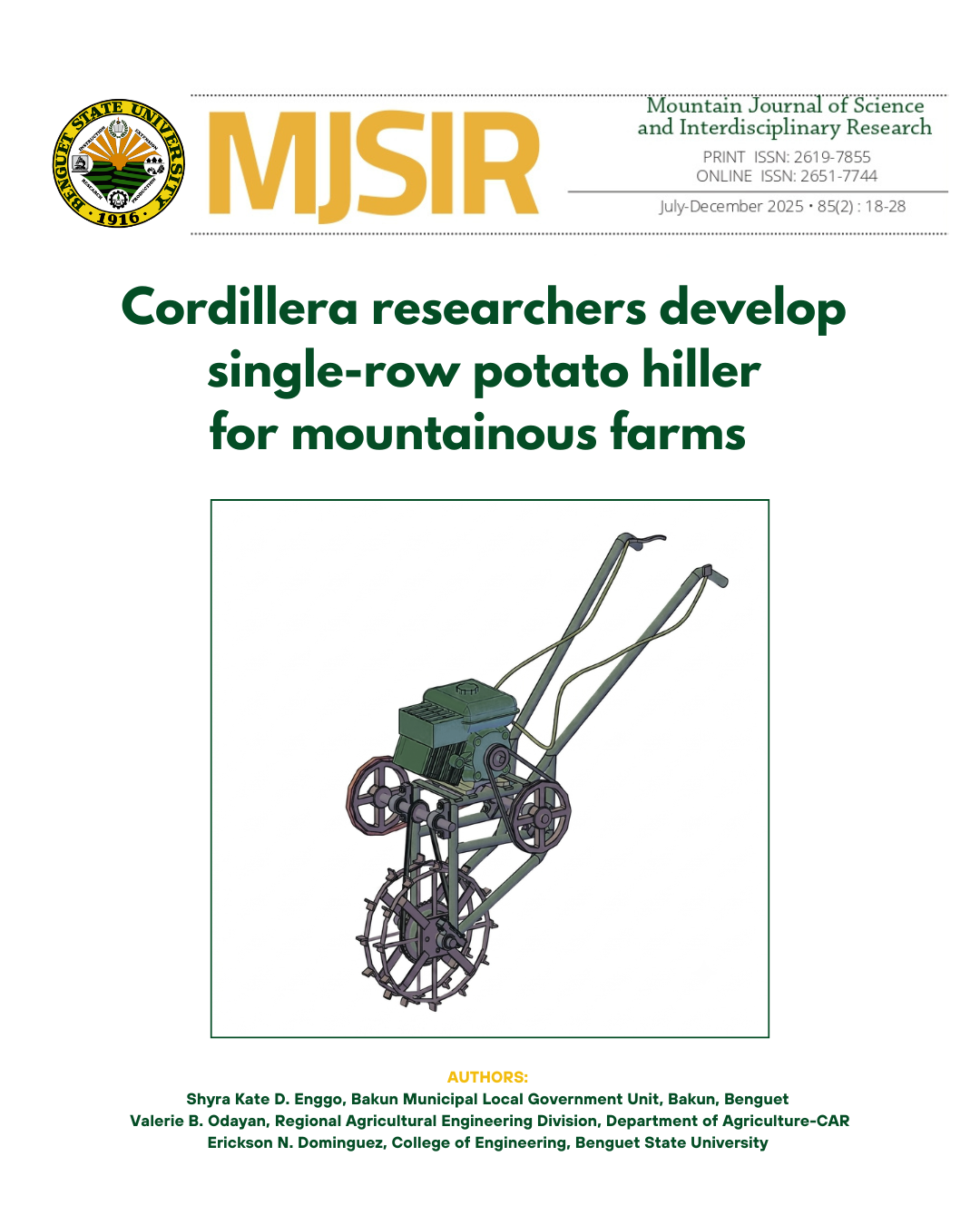
For potato farmers working on the steep, mountainous slopes of the Cordillera region, cultivating crops is backbreaking work. One of the most labor-intensive steps in this process is hilling, which involves molding soil around the base of the potato plants.
Hilling is a crucial agricultural practice. It loosens the surrounding soil to promote tuber development, improves plant stability, suppresses weeds, protects crops from pests, and facilitates fertilizer application. Furthermore, hilling blocks sunlight from reaching the growing potatoes, which prevents them from turning green and developing toxic levels of solanine.
In Benguet, the leading potato-producing province in the Cordillera, topographical challenges prevent the use of large farm machinery. Farmers, therefore, rely on manual hilling with grab hoes, a laborious and time-consuming process. Doing this on a one-hectare farm takes at least 10 days of manual labor. Additionally, manual labor does not guarantee uniform quality due to human factors that may leave potatoes improperly hilled.
Hoping to ease the burden on local farmers, Cordillera researchers Shyra Kate Enggo of Bakun Municipal Local Government Unit, Valerie Odayan of the Department of Agriculture-CAR, and Erickson Dominguez of Benguet State University developed a single-row potato hiller specifically for slope, mountainous farming areas. Fabricated using locally available materials, this push-type machine features a handle, prime mover, frame, wheel, transmission system, and the moldboard designed for hilling. The moldboard lifts the soil towards the base of the potato plants.
To evaluate the machine’s potential, the team tested it for field capacity, field efficiency, hilling efficiency, fuel consumption, and percentage damage to the potato crop. In particular, they tested three distinct moldboard designs of the machine: a conventional moldboard, a moldboard with a curved top, and a moldboard with a curved top and soil carrier.
The study revealed that the moldboard with the curved top and soil carrier delivered the best overall performance among the three moldboard designs. While this moldboard design performs faster than manual labor, its hilling efficiency is lower than manual methods. This is because farmers ensure potato plants are properly hilled in manual hilling.
Further, the researchers conducted a survey among 15 respondents engaged in potato farming. Based on the results, the moldboard with a curved top and soil carrier design achieved the highest percentage of satisfied respondents, which was 64 percent. According to the study, the initial cost of the potato hiller is PHP21,558.00, which covers the materials and fabrication labor.
Based on their findings, the researchers concluded that while the developed single-row potato hiller is not yet ready to fully replace manual hilling, it has potential for future development. Specifically, they recommend optimizing the moldboard design to enhance the machine’s performance. Ultimately, the improvement of the machine aims to ease the labor burden on potato farmers working on mountainous farms.
This study was published in the July to December 2025 issue of the Mountain Journal of Science and Interdisciplinary Research.//EBawayan