
12-13 March 2026
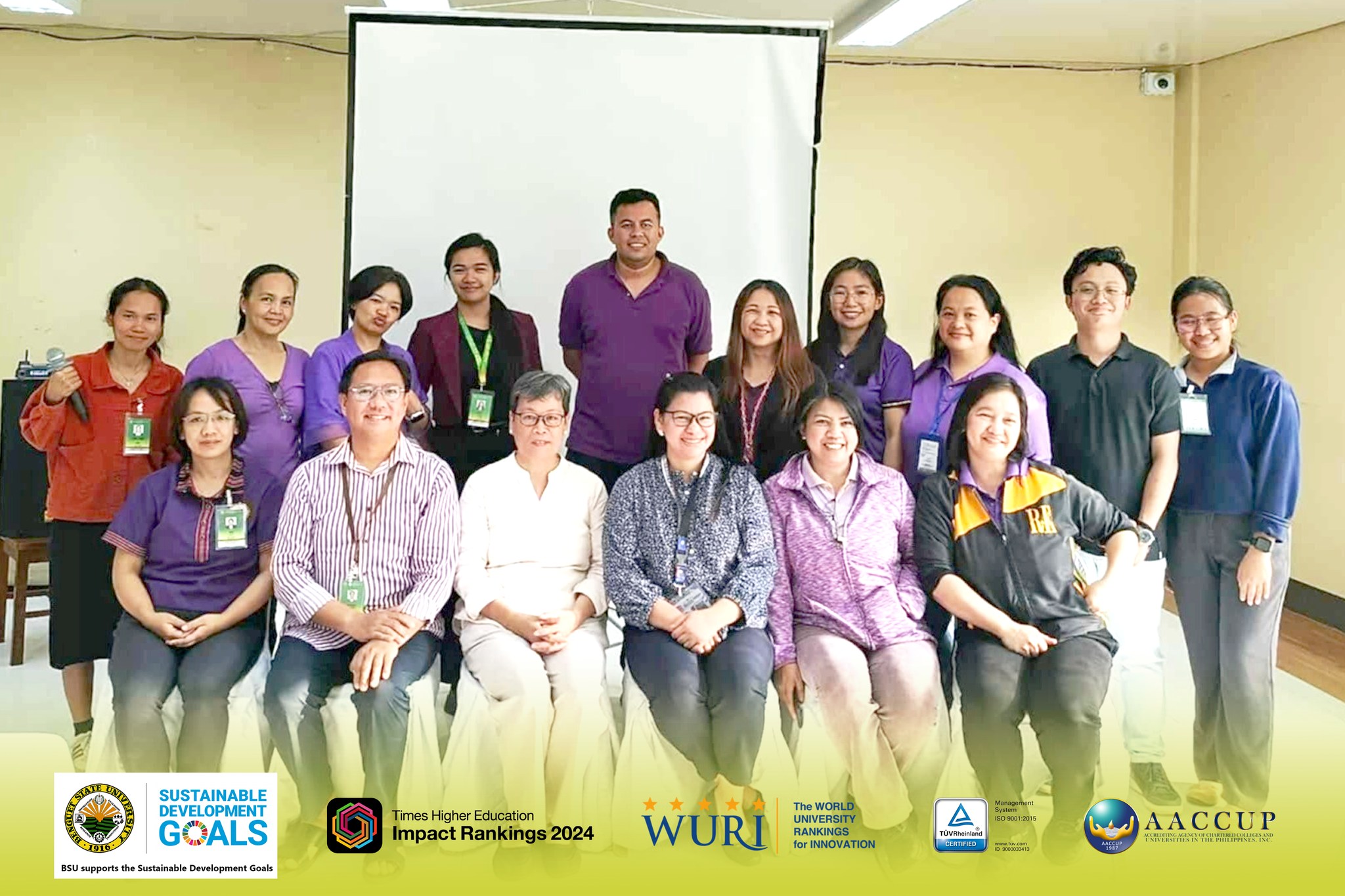
In line with its commitment to meritocracy, excellence, and equal opportunity, the Ad Hoc Committee conducted a two-day workshop at the RSDC Executive Hall to review and enhance the PRAISE (Program on Rewards, Awards and Incentives for Service Excellence) Everlasting Awards Policy. The activity also marked the introduction of the proposed IRISSE Recognition Program, a new initiative aimed at recognizing a broader range of contributors to the University.
The workshop was spearheaded by the Ad Hoc Committee created to review and update the PRAISE EVERLASTING policy. The committee is composed of representatives from different sectors of the University to ensure that the review process is inclusive and grounded in diverse perspectives. It is chaired by Patselyn A. Botiwey, with Imelda Degay as Co-Chair, and members Susan Pay-An Buasen-Ocasen, Bernadette Mating Bao-idang, Alma Doclisen Santiago, Rashid Berdin Lokines, and Donato Requino Wanawan, Jr. The group worked closely with PRAISE Chair and Vice President for Administration and Finance, Richard H. Kinnud, together with representatives from the teaching and non-teaching personnel, HRMO and HRDO.
This initiative also serves as part of the University’s preparation for PRIME-HRM Maturity Level 3 accreditation, particularly strengthening the integration of the Rewards and Recognition System with the other core HR systems: Performance Management (PM), Learning and Development (L&D), and Recruitment, Selection, and Placement (RSP).
The opening remarks were delivered by Kinnud, who discussed the foundations and history of the PRAISE Everlasting Awards Policy, highlighting its significance and impact on the University’s organizational structure since its inception. He also underscored the institution’s goal of advancing to the next PRIME-HRM maturity level.
He further cited concerns raised by the Commission on Audit (COA) regarding the granting of monetary awards to government employees due to non-compliance with existing rules and regulations. As an example, he mentioned the case of the City of Naga, where a ₱42.21 million workers’ bonus was disallowed for lacking proper documentation and for not meeting the criteria set under the Program on Awards and Incentives for Service Excellence (PRAISE).
This, he emphasized, highlights the importance of ensuring that the University’s recognition system remains compliant, transparent, and well-documented. He concluded by expressing his appreciation to all participants for their time and dedication, and by extending his sincere gratitude to the guests for their guidance and support.
Following the opening remarks, Ad Hoc Chair Botiwey presented an overview of the committee’s work and the rationale for the workshop. She emphasized that the committee was tasked to reassess existing awards and identify additional recognition mechanisms that better reflect the diverse contributions within the BSU community.
A key development that influenced the review process was the issuance of a Commission on Audit (COA) Audit Observation Memo (AOM), which prompted the committee to take a closer look at the provisions on monetary awards. The AOM underscored the need to ensure that all incentives strictly comply with government regulations. In particular, it emphasized that monetary awards should only be granted when measurable savings or tangible financial benefits result directly from an individual’s suggestion, innovation, or exemplary performance. Furthermore, such incentives must be supported by clear, verifiable documentation that establishes the link between the contribution and the actual savings generated. This reinforced the shift toward strengthening non-monetary recognition mechanisms within the PRAISE system.
The overview also highlighted the importance of aligning the PRAISE system with PRIME-HRM Maturity Level 3 standards, particularly through integrating performance management with rewards and recognition systems. A concern raised during earlier discussions pointed to the need for a more automatic and system-driven approach to identifying awardees. Initially, sectors were tasked to independently review their respective categories; however, the committee adopted a workshop approach to encourage collaboration, validation, and alignment of outputs. Technical support was facilitated through coordination with the Civil Service Commission (CSC), with guidance from former CSC Director Josefina Tamondong.
On the first day, Maria Geneva W. Nuarin, Chief Human Resource Specialist of the CSC-CAR, discussed CSC guidelines for the PRAISE Rewards and Recognition System, focusing on compliance with Maturity Level 3 indicators and best practices in policy enhancement. This was followed by a forum led by Tamondong, who emphasized the distinction between benefits and incentives and highlighted the role of supervisors in motivating employees beyond financial rewards. In the afternoon, participants reviewed awards and evaluation criteria according to their sectors.
During the discussions, the committee proposed that recognition for Contract of Service personnel, Job Order workers, alumni, retirees, and former members of the Board of Regents be presented separately from the PRAISE Everlasting Awards. This recommendation led to the development of the IRISSE Recognition Program.
On the second day, sectoral outputs were presented alongside the IRISSE proposal. Inspired by the iris flower, symbolizing wisdom, courage, and admiration, the program seeks to honor individuals whose contributions create a meaningful and lasting impact on the University and its stakeholders. The IRISSE program adopts a competency-based approach aligned with PRIME-HRM Level 3 and covers Job Order and Contract of Service personnel, service providers, alumni, retirees, stakeholders, partners, and former Board members. Awards are strictly non-monetary, in compliance with CSC–COA–DBM Joint Circular No. 1, s. 2017, and may include certificates, publication in Shamag, official announcements, and access to development opportunities.
The workshop successfully advanced the review of the PRAISE Everlasting Awards Policy and the development of the IRISSE Recognition Program. The outputs will undergo consolidation and further approval to ensure alignment with CSC standards and BSU’s continuing pursuit of excellence and inclusive recognition.//Rhema Pias-GIP Intern