17 – 18 June 2026
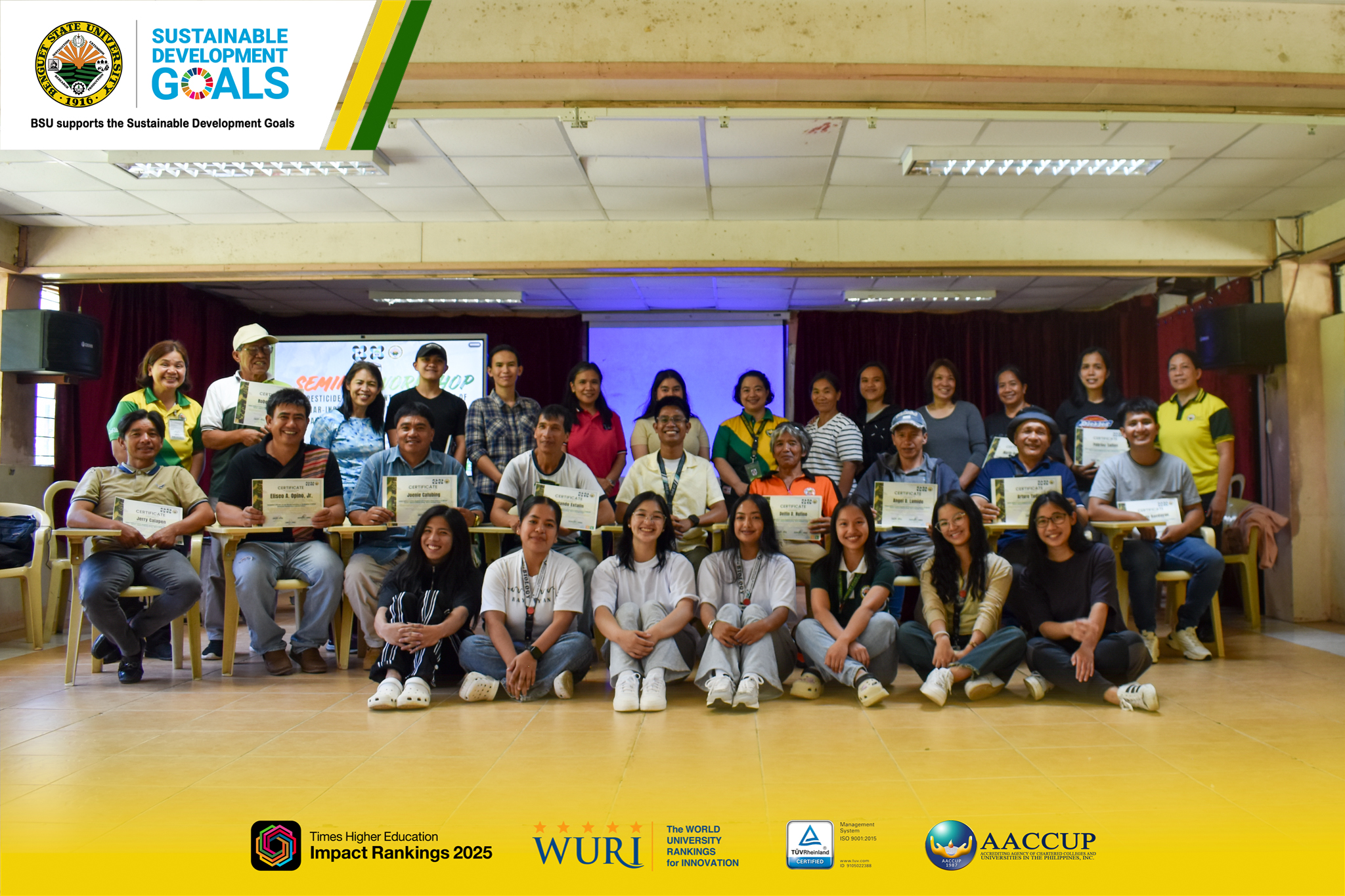
The Benguet State University convened farmers and focal point persons from the agricultural sectors of various local government units (LGUs) for the “Seminar Workshop on Pesticide Management and Integration of Biochar-Inoculated Plant Growth-Promoting (PGP) Microbes Towards a Balanced Fertilization Strategy (BFS) for Sustainable Farming” at the College of Natural Sciences (CNS) Little Theater.
The two-day activity served as a platform for knowledge sharing on responsible pesticide management, proper fertilizer utilization, environmental stewardship, and innovative microbial technologies that support sustainable agricultural production. It also encouraged stakeholder participation in identifying policy gaps and developing recommendations to strengthen agricultural programs and services.
The first day featured a series of lectures from experts representing regulatory agencies, environmental institutions, and research initiatives.
Rowena F. Billig, Benguet Provincial Officer of the Fertilizer and Pesticide Authority (FPA)–Cordillera Administrative Region, discussed the agency’s basic rules and regulations governing the sale, licensing, and registration of fertilizers and pesticides. She also provided participants with essential information on pesticides, emphasizing safe handling practices, proper application, and compliance with regulatory standards to ensure the protection of human health and the environment.
Meanwhile, Rogelio B. Tanguid, Regional Officer of the FPA–Cordillera Administrative Region, delivered a lecture on fertilizers and their handling and effective use. He underscored the importance of understanding soil properties and their influence on nutrient availability and fertilizer efficiency, highlighting how informed fertilizer management contributes to improved crop performance and resource utilization.
Addressing environmental concerns associated with agricultural inputs, Alice B. Guerrero, Supervising Environmental Management Specialist of the Environmental Management Bureau (EMB)–Cordillera Administrative Region, discussed agricultural hazardous waste management. Her presentation emphasized the significance of Republic Act No. 6969, or the Toxic Substances and Hazardous and Nuclear Wastes Control Act of 1990, and other environmental policies that guide the safe handling, transport, storage, and disposal of hazardous substances and wastes.
A highlight of the seminar-workshop was the presentation of Sherlyn C. Tipayno, Project Leader of the Bioremediation Project, on the utilization of biochar-inoculated plant growth-promoting (PGP) microbes for sustainable soil and crop management. The discussion showcased the potential of beneficial microorganisms as an environmentally sound approach to enhancing agricultural productivity while mitigating the impacts of pesticide use.
Tipayno explained that beneficial bacteria can promote plant growth and development through nutrient solubilization, phytohormone production, and enhanced tolerance to environmental stresses. Moreover, certain microbial strains possess the ability to degrade and detoxify pesticide residues in the soil, reducing their persistence and ecological impact. When integrated into a Balanced Fertilization Strategy, these microbial technologies can contribute to healthier soils, improved crop productivity, and more sustainable farming systems.
The lecture sessions concluded with an open forum that enabled participants to engage directly with the resource speakers and discuss concerns related to pesticide regulation, fertilizer management, environmental compliance, and sustainable agriculture.
The program also featured a testimonial from Eliseo Opino Jr., a cooperating farmer from Mankayan, Benguet, who shared his experiences in adopting improved farming practices and highlighted the value of science-based technologies in addressing challenges encountered by farming communities.
On the second day, participants took part in a collaborative brainstorming workshop focused on identifying gaps and needs in existing agricultural policies. The activity was facilitated by Lanelyn G. Atimpao, Provincial Good Agricultural Practices (GAP) Focal Person, and Cheryll C. Launio, Director of the BSU Office of Extension Services, with Matyline A. Camfilin-Talastas serving as moderator.
Through group discussions, participants examined policy implementation challenges and emerging concerns affecting the agricultural sector. The outputs of the three groups were subsequently consolidated and presented, generating recommendations that may contribute to the enhancement of agricultural policies, extension programs, and support services for farmers and agricultural stakeholders.
The seminar-workshop underscored the importance of integrating responsible agrochemical management, environmental protection, and science-based innovations in agriculture. By bringing together farmers, LGU representatives, researchers, and regulatory agencies, the activity strengthened collaborative efforts toward developing resilient, productive, and environmentally sustainable farming systems.//WMarcos