Have you ever invested your hard-earned money expecting higher returns and a secure financial future, only to be scammed? If so, you know how devastating it is. Beyond the painful financial loss, the psychological and emotional impact can be disturbing.
Every victim has their own story to share—how they were scammed, how it affected them, and how they managed to cope. These were revealed by BSU Faculty Member Dalifer A. Gano who studied the lived experiences of 15 investment scam victim-survivors.
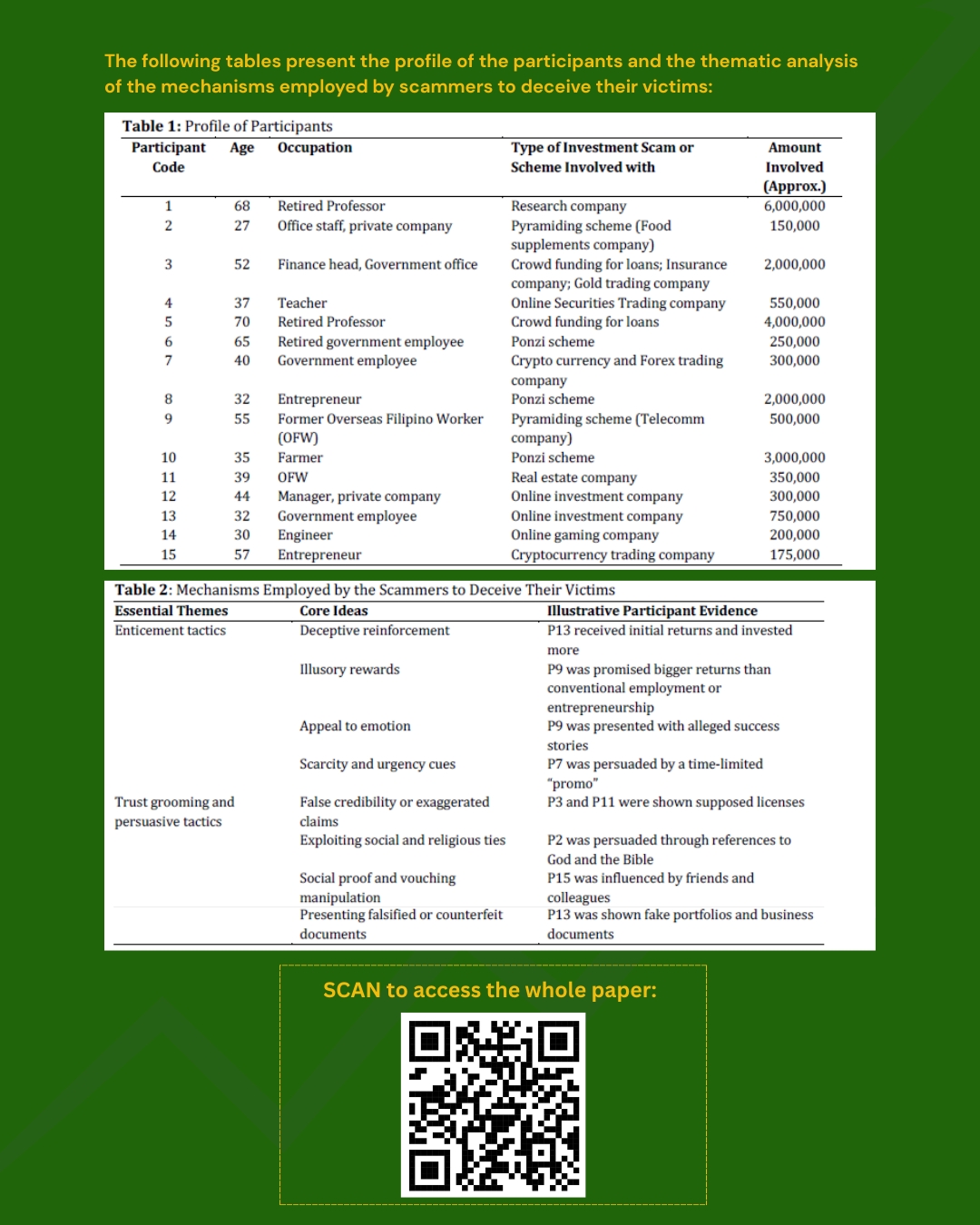
Investment scams are becoming increasingly serious global concerns, with perpetrators taking advantage of digital communication to exploit victims worldwide. Globally, the Philippines is among the countries with many recorded scam attempts and online victimization. As shown in Gano’s study, anyone can be targeted in a scam—including retired and current government and private employees, finance staff, entrepreneurs, Overseas Filipino Workers, farmers, and other professionals.
Gano’s study focused on investigating three areas: the mechanisms employed by the scammers from the perspective of victim-survivors; the impacts of the scam on the victims, their family members and peers; and the coping strategies of the victim-survivors during the aftermath of the scam.
The study revealed that scammers used a combination of financial enticement and trust grooming and persuasive tactics to deceive victims. Analysis showed that financial enticement involves tactics that make the investment appear profitable, urgent, and emotionally appealing. The trust grooming and persuasive tactics also make scammers appear credible, familiar, and socially or morally trustworthy.
According to the research, most perpetrators relied heavily on a classic grooming strategy in carrying out the scam, using a form of “bait” to attract potential victims into the investment scheme. This was followed by a series of manipulative strategies aimed at gradually strengthening trust to encourage progressively larger investments by the victims before the scammers eventually disappeared and cut all communication.
These scam experiences can be really devastating. The findings indicated that financial damage is the most immediate and visible consequence experienced by the victims, leading to reduced net income and the loss of long-term financial resources such as savings and retirement funds. Beyond financial loss, the scams burdened victims with emotional trauma, mental health struggles, social isolation, and a damaged self-concept making a ripple effect on their families and relationships.
Recovery from painful investment scams was a gradual and multidimensional process for the victim-survivors. This included efforts to cope, avoid further harm, and slowly rebuild their lives. In the study, the victims’ coping mechanisms included support from family and other people, financial survival strategies, reframing suffering into growth, and seeking formal and professional support.
Based on these findings, Gano concluded that investment scams are an increasingly urgent social problem requiring stronger awareness, prevention, and protection efforts. He then recommended an implementation of policy intervention, focusing on enhancing and expanding financial literacy and scam-awareness programs, strengthening digital fraud detection, enforcing stricter regulation of investment schemes, and establishing accessible reporting systems.
To address the financial, emotional, psychological, and family impacts identified in the study, the researcher suggested that the government should help victims access legal assistance, counselling, financial recovery guidance, and possible support or compensation mechanisms.
In an interview, the researcher mentioned plans for extension activities on investment scam awareness and further research to look into other types of scams within a localized context.
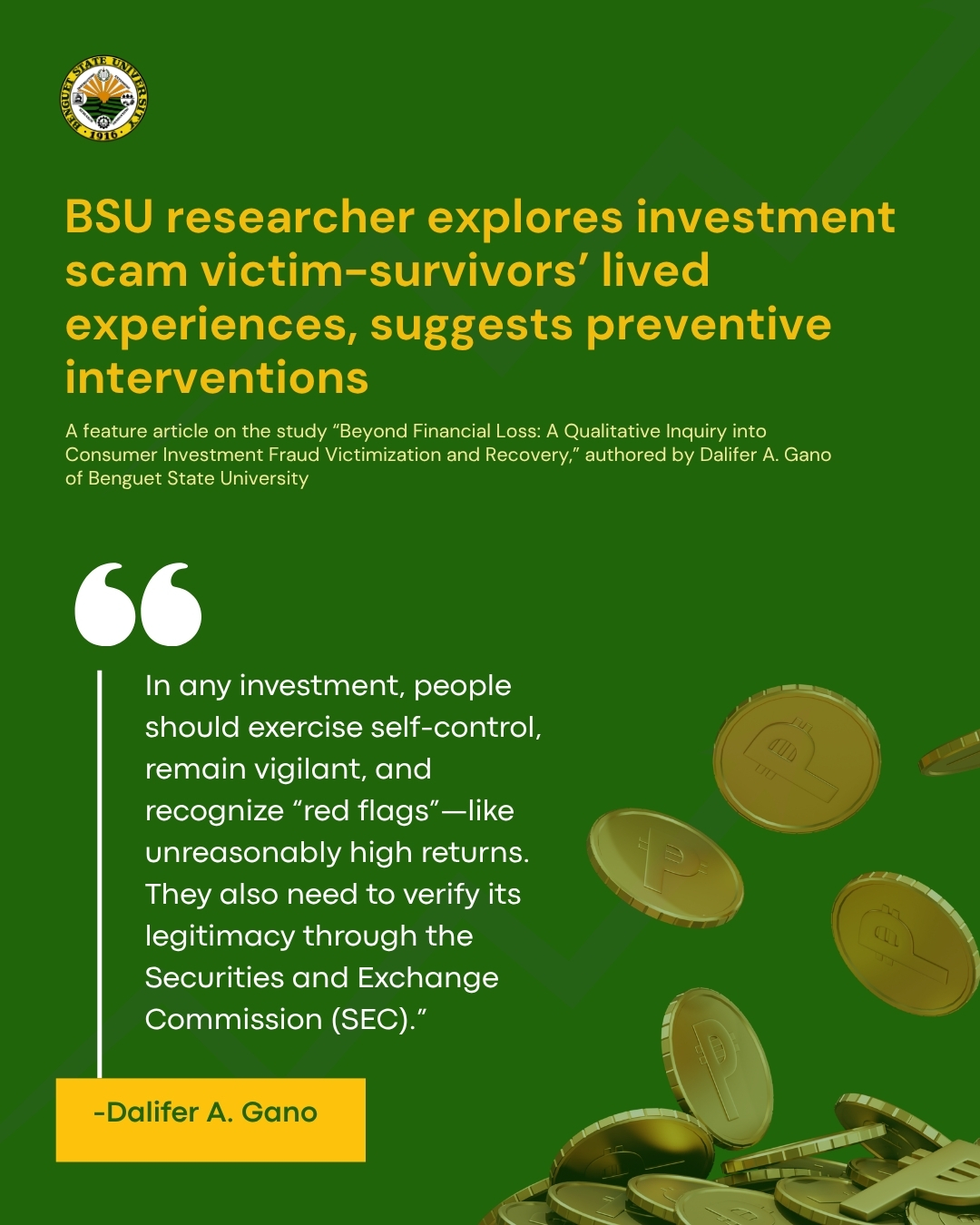
“In any investment, people should exercise self-control, remain vigilant, and recognize “red flags”—like unreasonably high returns. They also need to verify its legitimacy through the Securities and Exchange Commission (SEC),” Gano advised.
This research was published in the International Research Journal of Multidisciplinary Scope (IRJMS), 2026.//EBawayan